Account Intelligence & Scoring
Every number in the first version of a scoring model is a guess, and reps can smell it. Score an account 8 out of 10, be wrong twice in a row, and nobody opens that field again. For a national 3PL I built the layer that sorts the account list, and built it knowing that.
So the design is about being wrong usefully. Three separate questions instead of one blended score, measured data kept apart from inferred data, and a calibration loop whose only job is to say how wrong the first guess was.
The problem
The account list qualified companies on firmographics. Size, industry, location. That tells you whether a company is theoretically the right shape.
It tells you nothing about the three things that actually decide whether outbound is worth sending: whether they do enough volume to be worth serving, whether the way they operate genuinely fits, and whether right now is the moment.
So reps worked the list roughly top to bottom, and the only feedback loop was whether anyone replied.
The trap on the other side is worse. Ship a score nobody believes and reps go straight back to working the list top to bottom, except now there is a number on the screen making it look handled. A scoring model earns its place by being checkable, not by being clever, and that shaped every decision below.
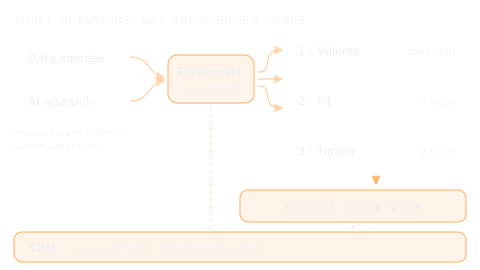
Three gates, kept separate on purpose
The key design decision was not to collapse the three questions into a single number.
A blended score hides which reason an account failed, and the right next action is completely different depending on the reason.
Gate 1, Volume. Pass or fail, not a score.
Are they big enough to be worth serving at all?
How the pass is decided
It passes if any one of several independent size signals clears a threshold: web traffic, a revenue bracket, company revenue, or confirmed order volume.
Any single one is enough, because each source covers a different slice of the market and none of them is reliable across all of it.
Gate 2, Fit. Scored 0 to 10.
Does the way this company operates match what we are good at? Six or better is a strong fit, four to five is possible, under four is weak.
What earns fit points
Points for their ecommerce platform, their marketing stack, whether they run paid social, whether they have internal operations headcount, product weight class, whether they sell direct rather than only through a marketplace, and whether they run a subscription.
Having no internal operations headcount scored highest, because that is exactly who needs the service.
Gate 3, Timing. Scored 0 to 10.
Should we move now? Six or better means reach out now, three to five is nurture, under three is watch.
What earns timing points
Points for a competitor's software showing up in their technology stack, a funding round inside the last twelve months, traffic growing fast, ad spend rising, open operations job postings, and detected shipping pain.
A recommendation then falls out of the combination: reach out now, nurture, watch and re-enrich in 90 days, or disqualify. A rep never has to interpret raw scores.
Where the data came from
Several third-party data providers covered the hard signals: web traffic and engagement, technology stack, funding and headcount, revenue brackets, product counts, social following, shipping carriers.
Then an AI research pass covered the things no data provider sells:
- Inferring product weight class from the catalog.
- Checking whether they sell direct or only through a marketplace.
- Reading job postings for operations hiring.
- Finding shipping complaints in public reviews.
- Writing a short narrative summary of what the company actually does.
Those inferred fields were stored separately from the purchased data and every one of them carried a confidence level. They were never blended in as if they had been measured.
That distinction matters more than it sounds, because the inferred fields are simultaneously the most useful and the most likely to be wrong.
The CRM is the source of truth
Everything landed back in the CRM as structured properties, 46 fields across 8 groups, written in a single update per account. Nothing lived in a spreadsheet. That one rule did most of the work.
- Lists build themselves. If the score is a field, a segment is a filter, not a data pull and a re-import.
- One place to look. A rep opening the record sees the same numbers the campaign was built on.
- Staleness is visible. Every account carries the date it was last enriched, so old data is findable instead of assumed fresh.
- Nothing gets orphaned. A score that lives in an analyst's spreadsheet is a score nobody uses.
Alongside the numbers, each account got a short plain-English narrative written back: what the company does and roughly how big they are, why they fit or do not, the single strongest signal driving the timing score, and the recommended next move.
Scores give you the ranking. The narrative is what a rep actually reads before picking up the phone.
Industry pods, and enriching before you send
The scores fed a campaign structure. Every account was tagged into one of nine industry pods, and each pod got its own list.
Campaigns then ran pod by pod instead of blasting the whole database, so the messaging could speak to how that specific industry actually ships.
The sequencing change was the bigger one. The early waves enriched after launching. The rule going forward was enrich first, then sequence, and tag the pod at import.
That way the list you send to has already been sorted by whether it is worth sending to.
Being honest about the accuracy
is what the scoring weights still are. The calibration loop that would grade them was designed as a later phase, not run. Until it runs, this is an opinion with numbers on it, and saying so out loud is what keeps a rep willing to use it.
These limits were written into the architecture up front, not discovered later:
- Web traffic estimates degrade badly on smaller brands, with error in the 30 to 50 percent range below a certain size.
- One provider's technology data ran three to six months stale, so a fresher source won any conflict.
- Order volume cannot be confirmed from outside. It is always an estimate, and it was labeled as one everywhere it appeared.
- AI-inferred fields carry a confidence level and are not treated as facts.
- And the big one. Every point value in the fit and timing tables was a hypothesis. A guess about what predicts a close, made before anyone had checked.
The loop that makes it a system
The scoring model was designed to grade itself.
- On every closed deal, record the confirmed order volume.
- Compare it to what the model estimated.
- Calculate the actual conversion rate against the traffic figure at the time of the close.
- After twenty to thirty of those, throw out the generic one-to-two-percent conversion assumptions and replace them with a real table by industry segment, built from your own wins.
That is the difference between a scoring model and an opinion with numbers on it. The first version is always guessing. What matters is whether you built the loop that tells you how wrong the guess was.
Why it matters
Most account scoring stops at firmographics, because firmographics are what the CRM ships with.
The work is not really in the enrichment. It is in deciding what the score is for, keeping the reasons separate so a failure tells you what to do next, and writing everything back where the team already works.
And in being explicit about which numbers are measured, which are inferred, and which are still hypotheses. That part transfers to any go-to-market team with more accounts than hours.