Sales-Call Analysis
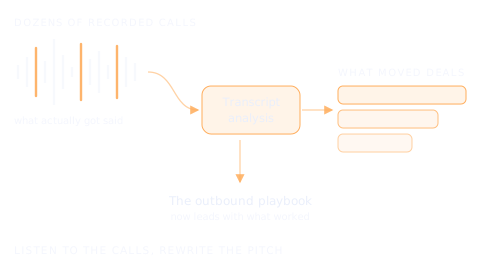
I watched nearly every call myself, and I would do that again even with the AI running. A national 3PL had months of recorded sales calls sitting in a folder, doing nothing. I pulled the transcripts and ran the whole set through AI analysis from eight different perspectives at once.
The listening is the half you cannot hand off. Reading across all of them at once is the half a person cannot do. Doing both is what turned a folder of recordings into something the team could use on the next call.
The problem
Sales calls get recorded and then forgotten. The notes pile up, nobody goes back through them, and the patterns that should shape the next pitch just sit there.
The team knew their calls held real signal about what buyers cared about and where deals got stuck. They had never sat down and pulled it out in one pass.
What I did
I worked through the full set of recorded sales calls, 73 transcripts in all, and separated the real prospect conversations from the internal syncs, post-sale onboarding, and no-shows.
transcripts down to roughly 35 substantive prospect calls, across about 25 distinct deals.
The half I would not automate
Then I did it two ways at once, and the split was deliberate.
I watched nearly every call myself, which is the part you cannot hand off if you want to feel where a conversation actually turns. It changed how I spend my own time on a call.
A transcript does not carry the moment a call turns. Tone, the pause before an answer, the polite thing that was not a yes. None of it survives into text, so analysis built only on transcripts is analysis of a sales team you have never actually heard.
The other half is where the machine is better than me. Nobody holds 35 conversations in their head at once and sees the pattern running through all of them. That is not judgment, it is volume, and it is exactly what to hand over.
So I ran the transcripts through AI analysis, reading the same corpus from eight different chairs.
The eight chairs
- The rep on the call.
- The CEO.
- A CRO.
- A VP of Sales.
- Coaching and enablement.
- The business.
- An investor.
- The customer.
Each lens asks different questions of the same conversation, and where they disagreed was usually where the useful thing was.
Out of that came a few things the team could actually use:
- An objection log. Every objection, grouped by type (pricing, single-warehouse coverage, contract terms, receiving speed, financial stability), with how often each came up, where in the call it surfaced, and how the deal turned out.
- A prospect-question bank. The questions buyers actually asked, sorted by capability, pricing, and process, plus every time a competitor got named so the team could see who they were really up against.
- Call-to-call continuity tracking. For deals that ran across several calls, I followed whether action items got closed, whether momentum held, and what was actually moving each one forward.
I pulled it together into a written analysis and a simple dashboard so it was something you could scan, not a wall of transcript.
The payoff
Once the patterns were on the page, they were obvious. The same handful of objections drove most of the friction.
Certain moves clearly helped, like bringing the founder onto higher-stakes discovery calls, and walking pricing as an all-inclusive per-order breakdown instead of a traditional rate card.
A lot of late-stage "pricing pushback" was not really a pricing problem. It was prospects not understanding line items on the rate card. That points at clearer pricing docs, not discounts.
All of it fed straight back into the outbound playbook and how the team framed the next conversation.
Why it matters
Most teams record their calls and never mine them.
The signal for what to say next is already there, in your own conversations, if someone takes the time to read across all of them and find the pattern. That is what this was. No new tool to buy.
Watch the calls, then have AI read them back to you from every seat in the company, and the pattern is right there in conversations you already paid for.
The judgment call was not which model to use. It was deciding which half of the job stays a human one, and then actually doing that half instead of pointing a tool at the folder and calling it done.